Trust as a security metric
In 2026, a business owner evaluating security options has more choices than ever before. There are national brands with massive advertising budgets. There are also DIY systems designed for simplicity and low upfront cost, regional business security providers, app-based monitoring platforms, and others.
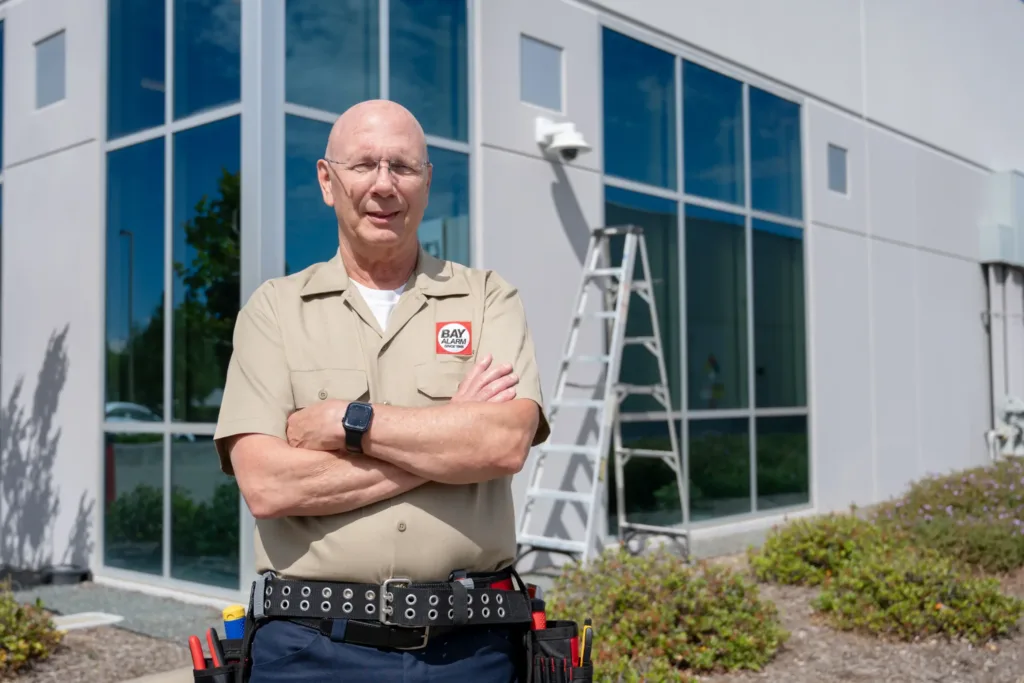
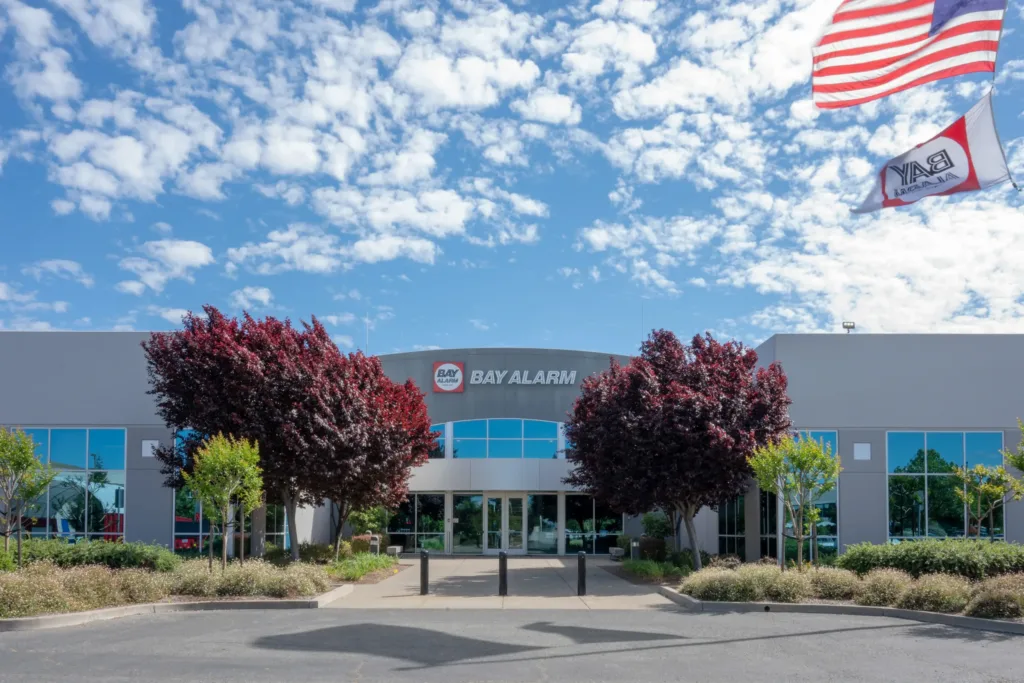
Bay Alarm’s answer to this complexity isn’t a longer feature list. Instead, Bay Alarm has been your local business security provider for the past 80 years. Our experts are monitoring from our own facilities in California, we are employing our own technicians, and we are working in the communities we live in.
When security is increasingly delivered by a remote platform, subcontractors, and an overseas call center, Bay Alarm offers the resources of a national provider with the specific knowledge and care of a family-run local business.
Why is being local a competitive advantage? Let’s explore.
How to choose a security provider for your business
The security industry has a structural fragmentation problem that most businesses don’t discover until they’re already a customer.
Many security providers, particularly at the national and franchise levels, operate through layered models. One company sells and installs the system, another monitors it, and a third handles service calls. The customer-facing brand is consistent, but the operational reality behind it often isn’t.
Imagine if an alarm triggers at 2 a.m., and the response chain involves multiple organizations operating under different protocols, then the accountability question (who is responsible for what, and how fast) becomes complicated.
In physical security, this is often called the contractor trap. In general, it refers to an organization’s overreliance on external contractors to manage, maintain, and secure a business and its assets. It’s intended to provide specialized expertise and rapid scaling, but instead, it can lead to significant challenges.
Bay Alarm operates its own UL-listed, Five Diamond-certified monitoring centers, which means the operator who monitors your property works for Bay Alarm, follows Bay Alarm protocols, and is accountable to Bay Alarm’s standards. There is no third-party monitoring handoff in our response chain.
A local security provider is in your community. This means faster response times and on-site support from technicians with extensive experience and local knowledge. Local providers also have established partnerships with local law enforcement agencies, fire departments, insurance companies, and others. What’s more, a local security provider can offer end-to-end service and a customized protection plan that fits your business.
Key differences between local and national security providers
- Service and support: Bay Alarm offers same-day emergency, on-site service from local offices across the West Coast, while national providers often use subcontractors or remote troubleshooting.
- Monitoring location: Bay Alarm’s monitoring experts are located in the UL-listed, Five Diamond-certified monitoring center in California. National security providers often outsource monitoring.
- Technicians and training: Bay Alarm technicians are in-house employees with an average of 2,000 training hours. They provide on-site, customized support. National or franchise providers often hire subcontractors for security technician jobs.
- Availability: Bay Alarm protects more than 155,000 businesses and homes across California, Arizona, and Washington, while national companies offer nationwide service.
Key differences between a DIY security system and a local security provider
DIY security systems cost less upfront, while a local provider like Bay Alarm offers professional installation and 24/7 expert monitoring, and ensures faster local response.
- Monitoring: DIY systems usually rely on self-monitoring via a mobile app, and if something goes wrong, you’ll have to contact authorities yourself. Bay Alarm offers proactive protection, backed by AI and experts working 24/7 at a UL-listed, Five Diamond-certified monitoring center. If an alarm is triggered, agents will immediately notify the fire service or law enforcement.
- Installation: DIY systems are easy to install. Bay Alarm provides professional installation, ensuring compliance with local fire and building codes.
- Reliability and maintenance: You have to manage and fix DIY systems yourself. Bay Alarm, on the other hand, employs local technicians, who install, maintain, and repair security and life safety systems during service visits.
Similar to the contractor trap of national security providers, DIY business security systems are limited in scope. One may fit a tech-savvy small business owner, but it won’t be appropriate for, say, a restaurant that requires a more tailored approach and compliance expertise.
The core limitation of any DIY business security system isn’t the hardware, but the absence of a professional relationship. No one assessed your risks. No one helped you design and install a security system. If an alarm is triggered, you’ll have to take action to determine whether it’s real and contact emergency services.
Questions to ask when choosing a security provider
- What is the provider’s specific experience with businesses of your type, in your region, and at your scale?
- Does the provider operate its own live monitoring center, or does monitoring go through a third party? What kinds of certifications does it have?
- Are the installation and service technicians company employees or subcontractors?
- How are system upgrades and technology changes handled over the life of the contract?
- What does the service agreement actually cover, and what does it exclude?
- What happens when something goes wrong?
- Does the provider have experience with local fire and life safety code requirements?
- Do they have existing relationships with local law enforcement that support effective alarm response?
The vertically-integrated security partner for your business
“Vertically integrated” is a term that comes from supply chain management. In a security context, it means that the same company that sells your security system installs, monitors, and services it, as well as owns accountability for every link in that chain.
That’s a different operating model from a national provider whose scale creates geographic distance between decision-making and service delivery. And it’s a fundamentally different model from a DIY platform whose business relationship often ends at the point of equipment sale.
Bay Alarm is a vertically-integrated security partner for your business. We employ the technicians who design and install your system. We operate the monitoring centers that receive your alerts. We dispatch the service teams that respond to maintenance or troubleshooting issues. We offer the latest state-of-the-art technology and support proactive security systems with continuous improvement capabilities. And with 80 years of knowledge about the specific risks, regulations, and communities we serve, we are a West Coast family-run business you can trust to protect your West Coast business.
Here’s what that means in practice:
- Faster response. When an intruder triggers an alarm on your property, a Bay Alarm monitoring expert can verify it and contact police while you’re not there.
- Personalized support. Bay Alarm technicians who install your system aren’t subcontractors picked from a dispatch pool for a one-time job. They’re Bay Alarm employees who document your installation, return for service calls, and can help with upgrades.
- Local knowledge. West Coast security has specific characteristics that a provider headquartered on the East Coast or operating from a national call center may not fully account for. They include evolving local regulations, law enforcement protocols, and specific regional risks.
- A relationship, not a contract. The security industry’s default model is transactional: sign a contract, get a system, call a hotline if something breaks. Bay Alarm’s model is a partnership.