The AI frontier: Physical security and cybersecurity converge
Eighty years ago, when Everett and Marj Westphal founded Bay Alarm in Oakland, CA, security closed-circuit TV (CCTV) systems entered the commercial market. They were manually operated, couldn’t record, and had to be live-monitored 24/7. A few decades later, in the 1970s, cameras became more common, and videos could be stored on VHS tapes. As the entire physical security industry transitioned from analog to digital in the 1990s, video data no longer had to be stored locally.
Still, until recently, security cameras were defined by analog, isolated hardware systems. They functioned as reactive tools for recording footage that could be reviewed and used as evidence after a crime occurred.
Modern security is proactive and integrated. It combines several technologies for a holistic system.
- AI-powered analytics transform cameras from passive recorders into proactive tools that can detect threats and take action, such as triggering warnings to trespassers in real time.
- Cloud-based storage offers centralized management, scalability, security, and remote access across multiple locations.
- Advanced access control systems use biometrics, keycards, and other cutting-edge methods for more secure and touchless entry.
- Sensors with AI detect environmental threats and trigger automated responses, significantly reducing false alarms.
- Autonomous technologies, such as drones or mobile surveillance units, provide an additional layer of security where traditional security methods fall short.
This new approach has significant implications for how businesses think about both physical and cyber security. AI-powered systems don’t just record—they interpret data, prioritize threats, and act. However, this new technology also carries a risk, as cameras and advanced sensors are networked and process data on the edge. The Internet of Things (IoT) and smart devices are easy targets for cybercriminals. The result is a need for a security posture that’s genuinely proactive and holistic.
Before we dive into live video monitoring to explain this new AI-centric approach to security, let’s explore why modern businesses have to start thinking about security in terms of both physical and cyber.

Why more data means less intelligence
The convergence of physical and cyber security is evident from the increasing interdependence of digital systems and physical assets, where breaches in one domain frequently cause immediate impacts in the other.
In cybersecurity, there’s a phenomenon called the log paradox, where organizations collect ever-increasing volumes of security data (from the many applications, devices, and servers) but extract less actionable intelligence from it. As a result, security teams face alert fatigue and context blindness, allowing real threats to slip through.
Similarly, in physical security, if you install cameras to cover every corner and entry point of your commercial facility, you will be increasing the amount of video footage recorded and stored. However, your security team won’t be able to monitor each and every camera feed 24/7, unless you keep increasing the number of your employees. If something happens, you will have footage of the incident, but you will have been too late to react and prevent it.
In both of these cases, AI can help process data and support security teams by discovering real threats and minimizing the number of false alarms. The volume of video being captured has grown far faster than the human capacity to review it. Without intelligence layered on top of that data, more cameras often just means more footage of incidents that weren’t stopped.
Keeping intelligence at the edge safe
Smart cameras with edge computing capabilities (or Edge AI) process data directly on the device in real time. They use built-in AI for such tasks as object detection, facial recognition, or reading license plates. If a camera detects a threat, AI will trigger a recorded message to deter intruders and alert security specialists to, in turn, alert first responders.
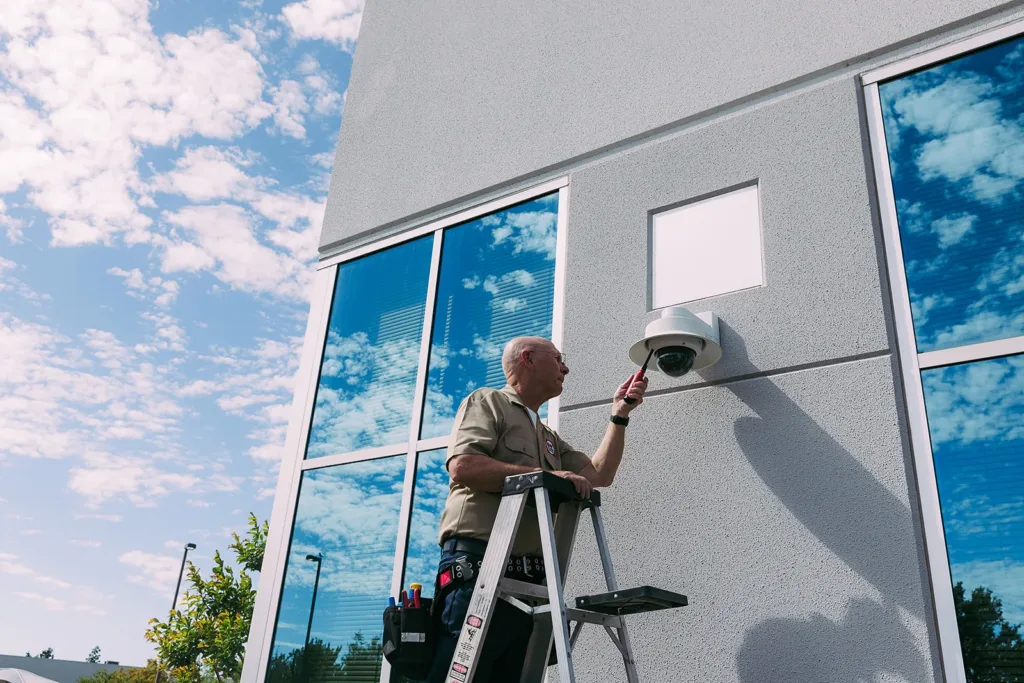
But smart cameras and smart sensors, if not installed and serviced by professionals, are vulnerable to cybercriminals. These devices process sensitive data locally, and unauthorized access can lead to data leaks.
A security camera connected to your business network is, from a cybersecurity standpoint, not fundamentally different from a laptop or a server. If it’s running outdated firmware, using default credentials, or connecting over an unsecured network segment, it represents a potential entry point for a bad actor.
In 2026, the convergence of physical security and cyber security means that the question “Is your building secure?” is inseparable from “Is your security infrastructure secure?” A DIY approach to this challenge can be tricky. That’s where a trusted security partner, such as Bay Alarm, comes in.
The benefits of AI-powered security cameras
Edge AI moves the brain into the camera and transforms its role from motion detection into precise threat detection.
With support from Bay Alarm’s video monitoring experts, AI-powered video surveillance deters 98% of crime.
Legacy motion detection treats all movement as equal. A flag rippling in the wind, a delivery truck pulling up, and a person approaching a rear entrance with a crowbar all trigger the same alert. The result: alarm fatigue. When everything is flagged, nothing gets prioritized, and real threats slip through.
AI-powered visual verification distinguishes between these scenarios. It classifies objects, tracks behavioral patterns, and identifies anomalies that match known threat signatures. A person loitering near a loading dock at 2 a.m. behaves differently from a vendor making a delivery. A vehicle moving slowly along the perimeter with the lights off is different from normal traffic. The system learns those differences and escalates accordingly.
When a smart camera pre-screens an alert and confirms the presence of a threat before escalating to a human, response time compresses because the video monitoring expert isn’t starting from zero. They’re receiving a verified, contextualized alert to act on immediately. In high-stakes situations, those seconds matter.
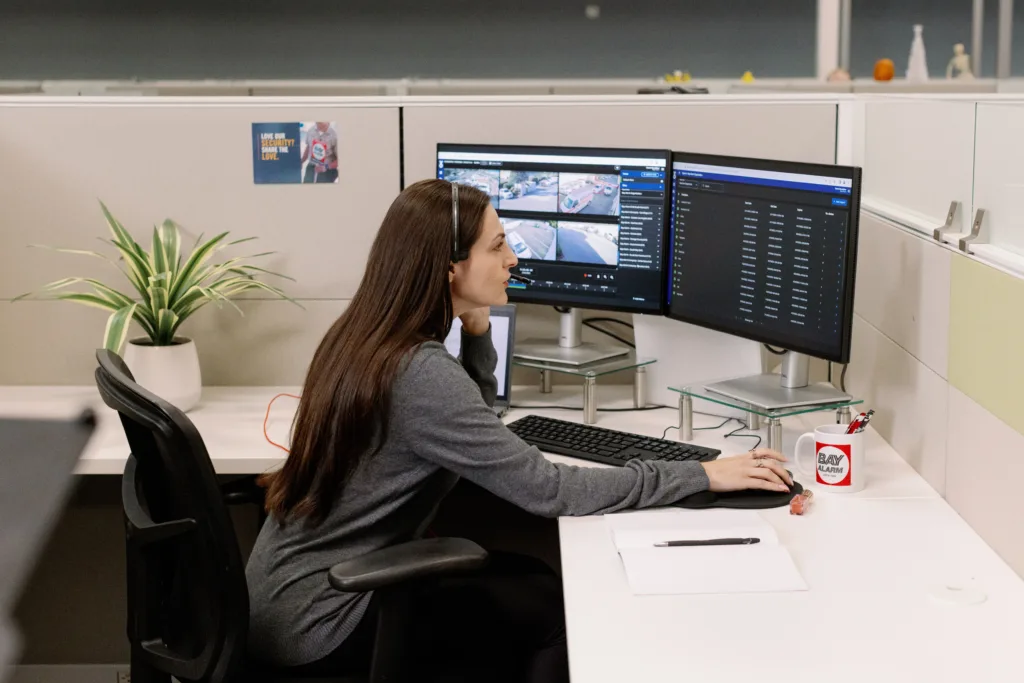
AI-integrated systems alert monitoring experts, who verify the threat before calling the police, further improving response times and reducing the number of false alarms. Researchers have found that 94-99% of all police responses to traditional alarm activations were false.
Visual verification is only half the equation. Once a genuine threat is identified, the window for intervention is narrow, and a passive system gives criminals a head start. Edge AI devices, for example, can deter trespassers in real time with automated speakers that engage directly with intruders.
Businesses protected by Bay Alarm’s live video monitoring regularly report preventing thefts of $5k to well over $100k per incident. Discover the ROI of live video monitoring.
The key benefit of AI is to give security personnel and monitoring centers better information, faster, with less noise. For modern businesses, such as Laborers Training School, live video monitoring and AI-powered cameras mean zero theft and fewer sleepless nights.
AI belongs in your security strategy. Start a conversation with a Bay Alarm security expert today.