Industry specialization: Specialized security solutions for your sector
In 2026, the security risks facing a fleet operator, a data center, or a restaurant are categorically different. The technology required to address them is different. The monitoring protocols are different. What’s more, the cost of getting it wrong is different.
After all, a construction site is very different from a data center. Yet many security service providers offer the same solutions for both. At Bay Alarm, we know that your business is unique and your security system should be too.
The invisible operational loss
The invisible operational loss in physical security refers to hidden costs arising from inadequate security controls. These security failures don’t announce themselves with a broken window or a triggered alarm, but quietly drain revenue, productivity, resources, and safety over time.
The invisible operational losses can include employee theft, inefficient processes, and operational downtime from outdated, misfit, or poorly monitored systems. Generic security systems aren’t designed to catch these losses. Instead, businesses should seek industry-specialized solutions.
Let’s look into several industries: auto lots, data centers, manufacturing, and hospitality.
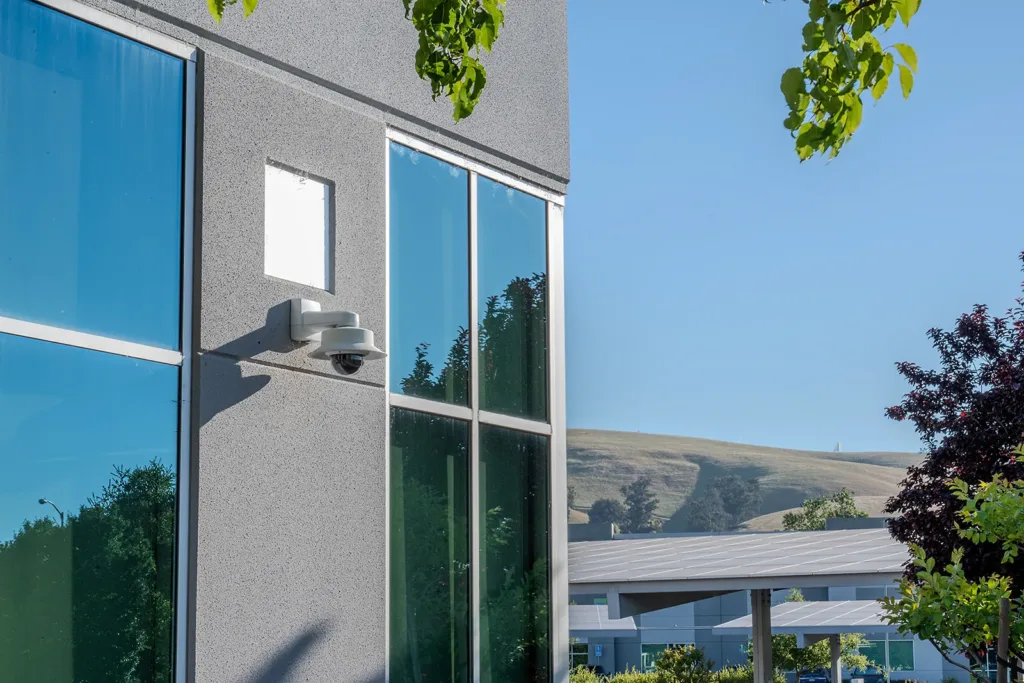
Fleet security: Protecting high-value assets in open environments
Transportation fleets, auto lots, and outdoor storage facilities represent a few of the most challenging security environments. They are easy targets for thieves due to a combination of factors, such as large perimeters, low foot traffic during off-hours, high-value vehicles and parts, and limited sightlines.
Organized criminal operations targeting fleet yards are less interested in stealing entire vehicles because modern GPS tracking has made it increasingly difficult to monetize. Now, the target is high-value components, including catalytic converters, copper wiring, batteries, and specialized parts that can be quickly removed and resold. These thefts often happen quickly, in the early hours of the morning, and aren’t discovered right away, but leave behind substantial damage.
Traditional perimeter fencing and basic camera systems are insufficient for the scale and nature of this threat.
The security strategy that best fits transportation fleets combines several elements:
- Solar-powered mobile surveillance units with AI-enhanced features that can be deployed anywhere on a large lot without infrastructure constraints
- An access control system that creates a documented record of every entry and exit from your auto lot
- Live video monitoring with audio deterrence that allows Bay Alarm monitoring agents to challenge suspicious activity in real time, rather than discovering it the next morning
- Motion-triggered lighting integrated with alarms and camera systems so that darkness, the fleet yard thief’s primary advantage, is eliminated
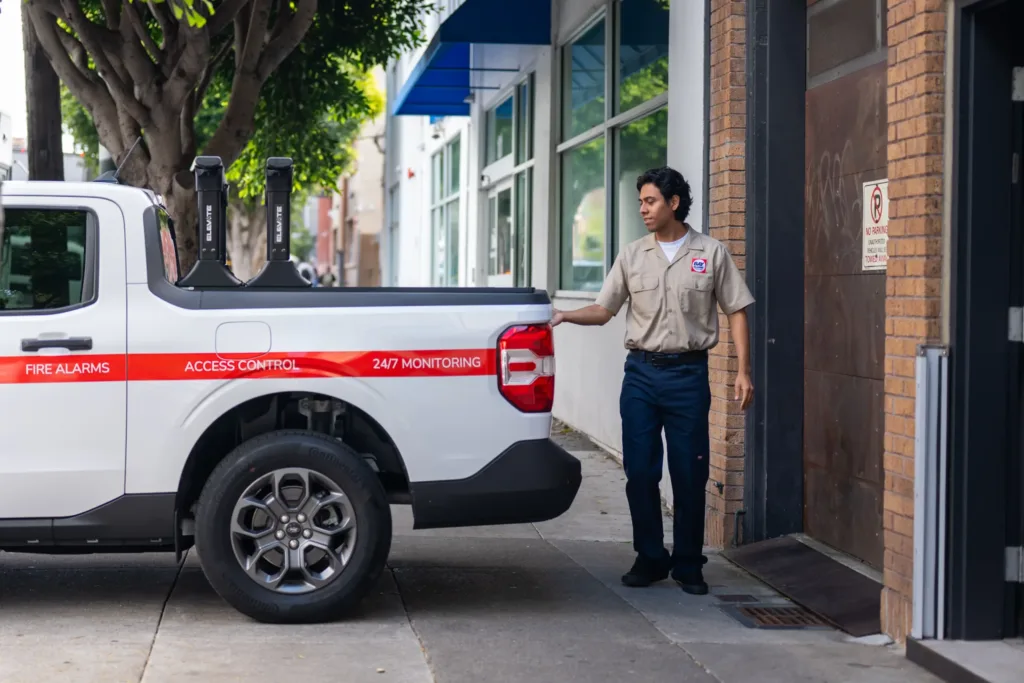
Copper theft: A problem for all outdoor operations
As we mentioned, auto lots and transportation fleets are often targets of copper thieves. Across the country and especially on the West Coast, copper theft has escalated; it’s happening on a larger scale and more frequently than before.
According to AT&T, the company experienced more than 2,200 copper theft incidents in California in 2024, compared to 71 in 2021. In 2025, the number grew to 7,300, with losses exceeding $54 million.
Any industry that uses copper is threatened, including:
- Telecommunications
- Transit systems
- Power utilities and infrastructure
- HVAC contractors
- Construction sites
For businesses in these industries, this trajectory makes proactive, comprehensive, and reliable deterrence a financial imperative, not an optional upgrade.
To effectively prevent copper theft and defend vulnerable locations from increasingly aggressive criminals, it’s essential to work with a security provider, like Bay Alarm, that offers technical expertise, cutting-edge security technology, and unmatched customer service.
Data center security: Preventing physical and cyber breaches
Data centers occupy a unique position in the security landscape. They are among the most physically hardened facilities in commercial real estate, and yet physical security failures remain a meaningful contributor to data breach events.
Close to 10% of data breaches were caused by a physical security compromise, at an average cost of $3.96 million per incident.
The physical environment in which servers operate is itself an attack surface. That’s a point often left out in data security conversations dominated by network security and endpoint protection. Each physical access failure, such as a tailgated door, a misconfigured visitor credential, or an unmonitored server room, can create a severe liability.
The security architecture essential for a data center reflects these high stakes and should include:
- Strong perimeter security, including high fencing, vehicle barriers, on-site experts, and 24/7 surveillance
- Inside, AI-powered video monitoring systems with motion-detection cameras and integrated alert systems
- Layered access control, where different areas of the facility require progressively higher levels of authentication, including biometric verification at the most sensitive zones
- Environmental monitoring, including fire alarms, smoke detectors, and other relevant monitoring systems, that conform to the latest security regulations
Manufacturing security: Protecting operational continuity
Protecting an industrial facility in 2026 means combining physical security, workplace safety, and an increasingly serious cyber-physical threat landscape.
In 2025, the manufacturing industry accounted for 27.7% of cybersecurity incidents, marking the fifth consecutive year that manufacturing was the most targeted industry for cyberattacks.
Using AI tools to identify weaknesses faster, cybercriminals are exploiting basic security gaps at dramatically higher rates. The reasons are structural. Manufacturing facilities run operational technology systems that were designed for efficiency and longevity, not security. Many of these systems are hard to patch and update, and increasingly, they are connected to enterprise networks that create pathways between the factory floor and the broader digital environment.
Equally significant is the physical security. In large manufacturing facilities, security is as much about operational continuity as it is about unauthorized access. Unauthorized entry into restricted zones creates safety risks for intruders and workers operating heavy equipment. Monitoring production floor activity for safety hazards is an emerging application of AI-enhanced video surveillance that blurs the line between security and operational management.
Moreover, equipment and inventory theft from industrial sites and warehouses represents a significant category of operational loss.
AI-powered video security systems can help professionals identify safety hazards, such as blocked emergency exits or workers entering restricted areas, and track high-value equipment to detect unusual movements or usage patterns that may indicate theft, tampering, or unauthorized access.
For manufacturing businesses, access control must incorporate unique requirements. Contractor and vendor access, for example, creates credential management challenges that a consumer-grade or DIY system is not designed to handle. Cloud-based access control platforms that can issue time-limited credentials, log every entry and exit, and revoke access in real time are the appropriate solution for industrial facilities.

Restaurant and hospitality security: Protecting people
Restaurants occupy a security category that combines elements of retail, hospitality, and small businesses. Restaurants’ risk profile is shaped by high cash volumes, late-night operations, frequent staff turnover, and facilities that are designed for accessibility rather than security.
The most significant physical risks in restaurants include:
- After-hours break-ins targeting cash registers and safes
- Internal theft, which the food service industry acknowledges as a persistent challenge
- Theft and vandalism in parking areas and delivery zones that occur outside operating hours
Professionally monitored video surveillance (cameras covering cash handling areas, entry and exit points, and exterior parking) can serve both as a deterrent and documentation in the event of an incident or insurance claim.
Audio deterrence can be particularly effective. An after-hours intruder who hears a security monitorins a silent alarm that may or may not prompt a response.
Access control in restaurant environments addresses a specific operational vulnerability: key management. In a business with high staff turnover and multiple keyholders, the exposure created by unreturned keys is a recurring and often underappreciated security risk. Transitioning to a cloud-managed access control system with mobile or fob credentials that can be revoked instantly eliminates that exposure.
Then there are regulatory requirements for food service businesses, including fire and life safety systems. They require regulatory expertise and customized design and installation that fit a business’s specific needs, not generic fire alarm packages.
Protect your business with security solutions customized to your needs
Generic security systems protect against generic threats. Each business, on the other hand, faces specific risks that require specific solutions.
Bay Alarm saved Laborers Training School over $100K a year by eliminating theft and vandalism of high-value tools and assets, including catalytic converters, generators, and welding equipment.
With 80 years of experience across the West Coast’s most demanding industries, Bay Alarm can design a security solution for the operational realities of your specific risks, industry, location, regulatory requirements, and business needs. Contact our security professionals today.