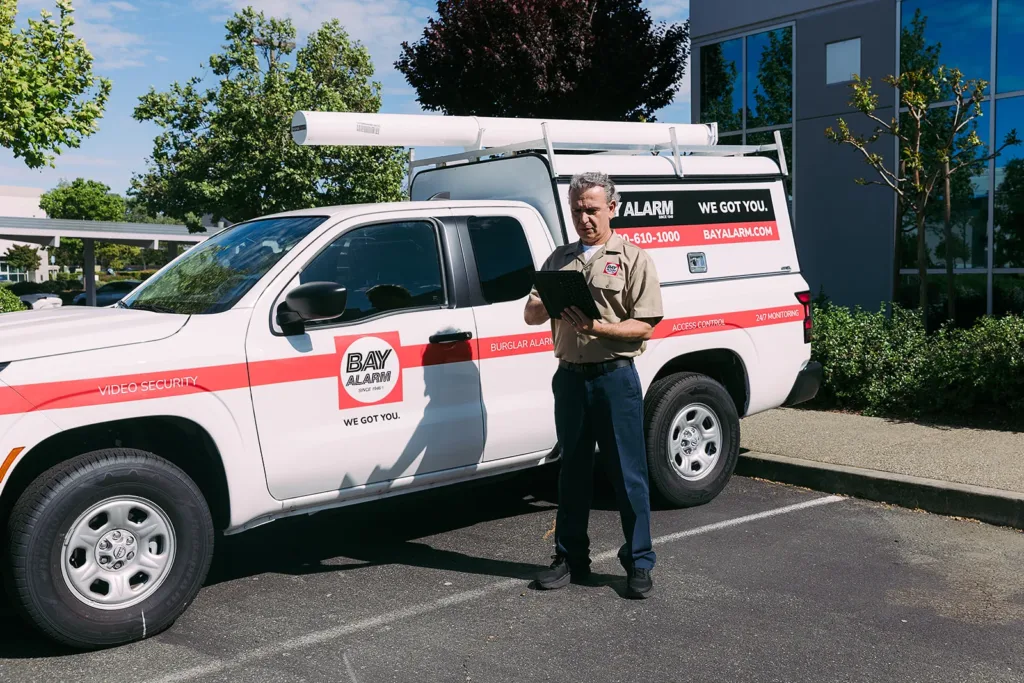
In 2026, Bay Alarm celebrates 80 years of protecting businesses and homes in California, Arizona, and Washington. Eight decades in the security business taught us that threats multiply and criminals continuously adapt, while security strategies can often struggle to keep pace.
No industry is immune. Construction companies lose billions to construction sites’ thieves, with most stolen equipment never recovered. Similarly, retailers are grappling with increasing levels of theft, violence, and organized retail crime that have become a persistent threat.
Explore our comprehensive guide to business security to learn about the 2026 security trends and risks, and how to build a robust security system capable of protecting your business.
The new framework for business security systems
For most of Bay Alarm’s history, business security meant protecting the perimeter. Lock the doors, install fences, arm the alarms, and station security guards. If something goes wrong, react.
Traditionally, a good protection strategy involved three main layers:
- Deterrence systems
- Physical barriers and access control
- Surveillance technologies
This strategy still works, but now, protecting the perimeter is not enough. Modern businesses have to be prepared for a variety of threats, both physical and digital, at all times.
Top security risks in 2026
AI has transformed cybersecurity risk, and it is also affecting physical security. For one, a clear boundary between the “inside” and “outside” doesn’t exist anymore. That’s why environmental factors, as well as insider threats and employee negligence, are important to account for. For the other, criminals aren’t easily deterred and have access to the latest technology. This calls for a trusted security partner who understands the modern threat landscape.
AI-enhanced reconnaissance
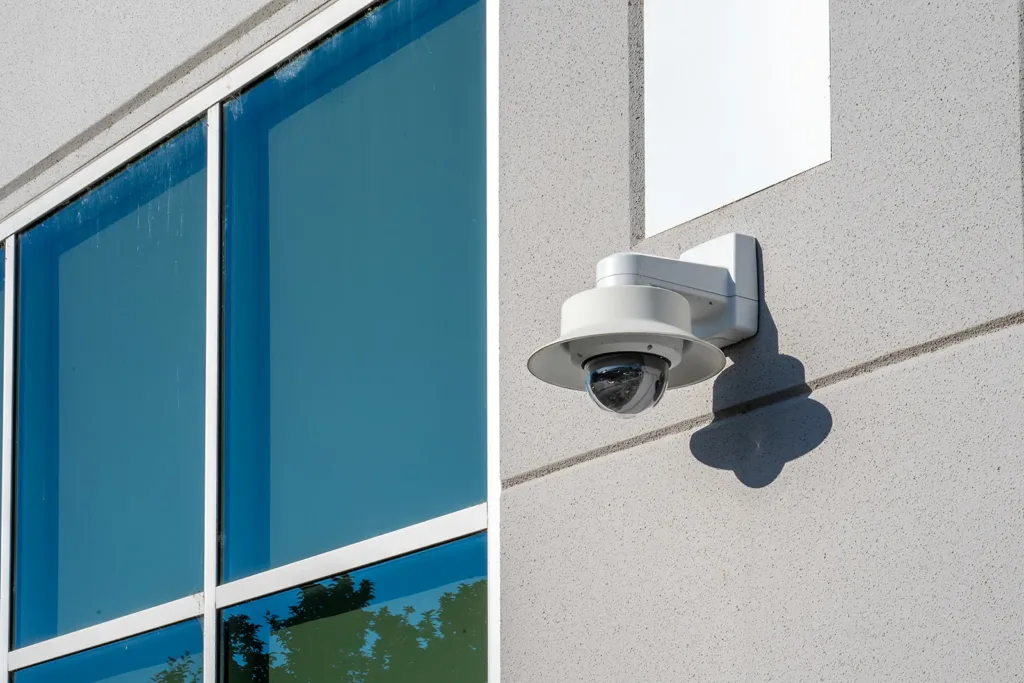
Criminals are increasingly using AI tools to identify and exploit vulnerabilities before they ever set foot on a property. What once required skilled reconnaissance can now be easily automated. Criminals can analyze publicly available data, camera blind spots, and patrol patterns to identify the path of least resistance. These threat actors are often better informed about potential vulnerabilities in physical barriers, surveillance systems, or access controls than many business owners are themselves.
Learn how AI can protect your business.
Signal jamming
Favored by many small and mid-sized businesses, DIY wireless security systems that are affordable and easy to install carry a significant weakness. An off-the-shelf jamming device can easily defeat them, allowing criminals to blind surveillance and disable access controls. These jammers disrupt WiFi and radio frequencies, creating blind spots for cameras and unlocking secured vehicles or entry points. Jammers also prevent alarm signals from reaching a monitoring center.
Read the latest security insights for small businesses.
Legacy infrastructure
Outdated access control systems and aging surveillance cameras create operational drag and blind spots that cannot support modern analytics, increasing exposure to both physical and cyber threats. Legacy systems are typically slower to respond, lack remote access, increase false alarms, and have limited integration ability. In an emergency, a slight delay or inefficiency can mean the difference between stopping a crime and becoming the victim of one.
Learn more about the key security trends in access control.
Environmental threats
West Coast businesses also face a threat that no burglar alarm was designed to stop. Wildfire seasons have grown longer, more unpredictable, and more destructive — and the risk isn’t only to physical property. Smoke damage, power disruptions, evacuation logistics, and the ability to monitor facilities remotely during a crisis present operational and security vulnerabilities. In 2026, a business security plan that doesn’t account for environmental risk is an incomplete one.
Discover the 2026 compliance changes that might affect your West Coast business.
Human factor
Last but not least in the list of risks is the human factor. Human actions can undermine even the most sophisticated technology, and the vast majority of security incidents involve human error or overlooked procedures. That’s why businesses across industries have to watch out and account for challenges ranging from insider threat to office tailgating, internal theft, and employee negligence.
Take our free security assessment to learn about your vulnerabilities.
The efficient security strategy in 2026: From reactive to proactive
The old model of business security was reactive by design: something bad happens, an alarm sounds, and someone responds. That’s still part of the equation, but it’s no longer enough.
Today’s threats, such as AI-assisted surveillance, signal jamming, insider risk, or environmental disasters, don’t trigger an alarm. They exploit gaps in coverage, communication, and coordination.

A siren on a wall can’t handle a coordinated, technology-enabled intrusion, or a wildfire bearing down on an unmanned facility over a holiday weekend. Modern businesses need security systems that can see more, verify faster, and coordinate their communications.
Every business is different. Discover how to overcome security challenges in 2026 in your industry.
The businesses best positioned in 2026 are those that are shifting to what we call proactive intelligence. This includes integrated systems that detect incidents, anticipate conditions, verify threats in real time, and keep operations running through disruptions.
What does proactive monitoring look like in practice?
- A unified operational picture: Instead of isolated alarms, proactive intelligence entails integrated life safety and security systems that share data across fire detection, access control, video surveillance, and environmental monitoring.
- Verified response protocols reduce false alarms and ensure law enforcement and first responders are dispatched when every second counts.
- Remote monitoring helps with business continuity planning and keeps you informed and in control—even when off-site.
- A security partner, not just a security vendor: someone who understands your specific facilities, risks, and operations, and can adapt your system as threats evolve.
Learn more about the benefits of working with a vertically-integrated security partner.
For Bay Alarm, security isn’t a product you install and forget. It’s an ongoing relationship between technology, monitoring expertise, and the people who have been keeping businesses safe for 80 years.