Imagine trying to spot an intruder in a pitch-black warehouse or noticing a machine overheating before it catches fire. Our eyes are incredible tools, but they have limits. They need light to see, and they can’t see heat. This is where technology steps in to fill the gap.
Thermal cameras act like a superpower for your security system. They don’t just record video; they detect heat signatures that are completely invisible to the naked eye. While you might associate this tech with action movies or military operations, it has become a useful tool for businesses of all sizes.
In this guide, we are going to break down exactly what thermal imaging for security is, how it helps prevent devastating fires, and why it might be the upgrade your commercial property needs.
Why thermal imaging is essential for commercial fire prevention
Fire is one of the most destructive threats a business faces. Traditional smoke detectors are the baseline requirement for fire safety and insurance, but they often trigger only after a fire has started and produced smoke. By then, the damage has already begun.
Thermal imaging takes a proactive approach. These specialized cameras can detect rapid rises in temperature before a flame ever sparks, giving you and your monitoring team more time to react and prevent loss.
Think about a server room filled with expensive electronics. If a server starts to overheat due to a malfunction, it will generate significant heat long before it bursts into flames. A thermal camera monitoring that room can “see” this temperature spike.
Let’s break down three benefits of thermal detection:
- Early warning: The system can alert security teams or facility managers immediately.
- Targeted response: You can pinpoint exactly which piece(s) of equipment is overheating.
- Prevention: You can shut down the equipment before a fire starts, saving assets and preventing downtime.
This capability is crucial for industries that store flammable materials, operate heavy machinery, or manage large data centers. It changes the game from “fighting fires” to “preventing fires.”
How thermal imaging for security works
To understand how this works, we need to talk about the electromagnetic spectrum. For this blog, we’ll keep it simple!
Everything around us—people, animals, engines, even ice cubes—emits thermal energy, or heat. We can’t see this energy with our eyes because it exists as infrared radiation. Standard security cameras work much like our eyes; they capture visible light bouncing off objects. If there is no light, there is no detection.
Thermal cameras are different. They have special sensors that register heat radiation rather than visible light. They translate these heat signatures into an image we can see on a screen.
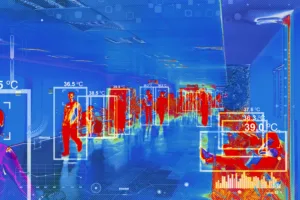
Usually, these images show hotter objects as bright colors (like red, orange, or white) and cooler objects as dark colors (like blue, purple, or black).
Because they rely on heat, not light, thermal imaging for security is effective in conditions where standard cameras fail:
- Total darkness: They don’t need streetlights or infrared illuminators.
- Visual obstructions: They can see heat signatures through smoke, light fog, and foliage.
- Bright light: They aren’t blinded by direct sunlight or headlights.
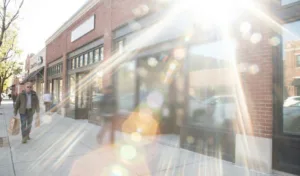
This makes them incredibly reliable for 24/7 monitoring. An intruder hiding in dark bushes might be invisible to a regular camera, but to a thermal camera, their body heat makes them stand out like a beacon.
Thermal imaging applications: Who is this good for?
You might be thinking, “This sounds high-tech, but do I really need it?” While thermal technology used to be prohibitively expensive, it is now accessible for a wide range of businesses.
It is not just for top-secret government facilities. Here are a few examples of who benefits most from thermal imaging for security:
- Manufacturing plants: Monitoring machinery for overheating parts to prevent breakdown and fire.
- Warehouses and logistics centers: protecting large perimeters where lighting every corner is expensive or impossible.
- Auto dealerships: Securing expansive outdoor lots at night without creating light pollution.
- Construction sites: Detecting intruders who might be stealing expensive materials under the cover of darkness.
- Healthcare facilities: Monitoring body temperatures in high-traffic areas or securing sensitive storage.
Essentially, if you have a large perimeter to protect or critical equipment that generates heat, this technology is a strong candidate for your security plan.
Advantages of thermal imaging systems over standard detectors
When you are building a security strategy, you want tools that give you the best information with the fewest false alarms. This is where thermal cameras shine.
Standard motion detectors often struggle with the outdoors. A blowing tree branch, a wandering stray cat, or a sudden shift in sunlight can trigger a motion sensor. This leads to “alarm fatigue,” where security personnel stop taking alerts seriously because they are wrong so often. It’s important to ensure your security system doesn’t become the sensor that cried wolf.
Thermal cameras reduce these false alarms significantly. Since they look for heat signatures (like a human body or a warm engine), they can ignore things like:
- Moving shadows
- Insects flying close to the lens
- Blowing leaves or debris
Furthermore, thermal cameras have a much longer range than most standard cameras. A single thermal camera can often cover the same perimeter distance as multiple standard cameras, potentially reducing installation and maintenance costs.
According to the National Institute of Standards and Technology (NIST), advanced sensor technologies are critical for modern fire safety and security, highlighting the shift toward smarter, data-driven detection methods.
At Bay Alarm Company, we often recommend integrating thermal solutions for businesses that need robust perimeter protection and fire risk mitigation. It adds a layer of intelligence that standard video just cannot match.
Thermal imaging for security FAQ
We know diving into new technology raises questions. Here are some of the most common things people ask us about thermal imaging.
Can thermal cameras see through walls?
No, contrary to what you see in movies, thermal cameras cannot see through solid walls, glass, or water. They detect the surface temperature of the first object in their line of sight. However, if a wall is very hot because of a fire inside, the camera might detect that heat transfer on the surface.
Are thermal images clear enough to identify a face?
Generally, no. Thermal cameras are excellent for detection (knowing someone is there) but not great for identification (knowing who it is). They show heat blobs, not facial features. That is why we often pair thermal cameras with high-definition standard cameras. The thermal camera spots the intruder, and the standard camera zooms in to get the details.
Does thermal imaging work during the day?
Yes! Because they detect heat, not light, they work just as well at noon as they do at midnight. In fact, they can be better than standard cameras during the day if there is a lot of glare or shadows that might hide an intruder.
Is it expensive to maintain?
Modern thermal cameras are durable and require similar maintenance to standard security cameras. Since you often need fewer of them to cover a large area, the long-term maintenance costs can actually be quite competitive.
Final thoughts
Investing in thermal imaging for security is more than just buying fancy cameras. It is about giving your business the ability to see the unseen and buy time to shut down a potential threat. Whether it is spotting an intruder in the dark or catching an overheating machine before it causes a disaster, this technology offers peace of mind that standard security just can’t touch.
Updated on: June 5th, 2026